← /3/

Making planet maps

New launches split creator fees 50% to the poster and 50% to the launcher. No tripcode is needed to launch; poster claims require verified ownership.

Anonymous06/13/26(Sat)08:57:02 No.1029513
c4Yxc (1)
Maybe the wrong place for this, but I think it fits the topic.

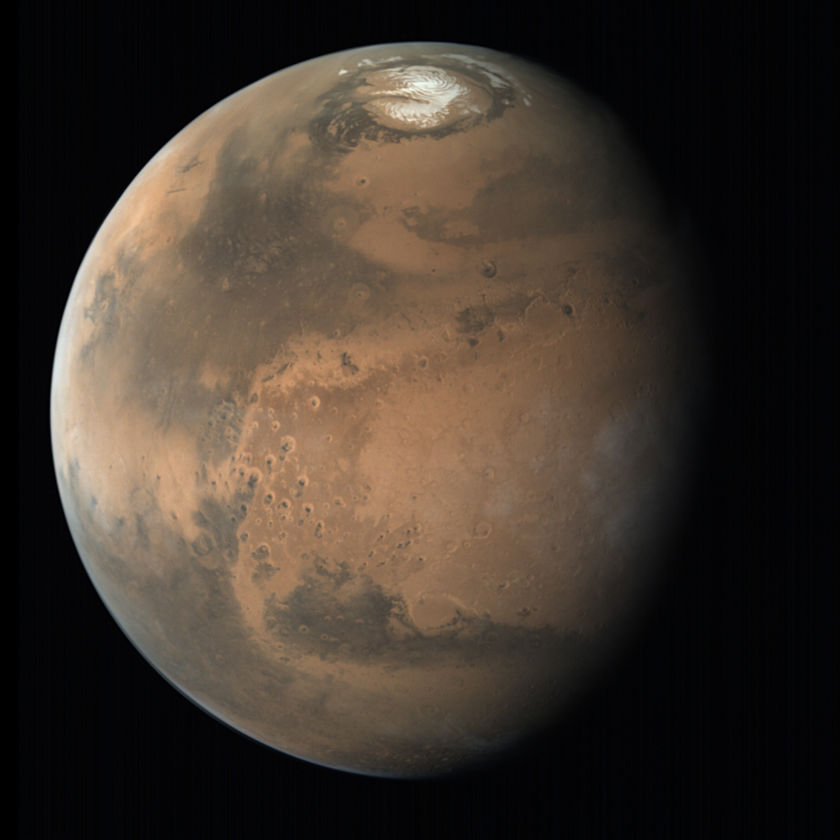
I want to know how to create unique planet maps with custom terrain types (like salt flat plains, basalt dunes, ice caps etc.). I want mountainous erosion, glaciers, stuff like that, and natural looking landforms that don't just look like perlin noise. The map must have a heightmap and a colourmap, and height shouldn't strictly be tied to landforms like SpaceEngine does. For this specific project I'll also need shield volcanoes and equatorial ice caps (it's a tidally locked world). Can anyone point me in the right direction like what software/toolkits I need? And also, is it possible to make highly customised cloud maps for my world, like subsolar vortexes, wispy terminator clouds etc.? The maps must be either equirectangular or cubemap projection.
Anonymous06/13/26(Sat)08:58:08 No.1029514
Sorry, I meant hemispheric ice caps, not equatorial.
Anonymous06/13/26(Sat)08:58:39 No.1029515
Oh, and the world has a stagnant lid surface, so no need for tectonic plate simulations.
Anonymous06/13/26(Sat)16:18:12 No.1029523
>>1029515
Nevermind it, I figured it out.
Anonymous06/15/26(Mon)02:22:23 No.1029550
Imo the hard part is making them round
Anonymous06/25/26(Thu)19:48:11 No.1029853
>>1029523
so how do you do this?

I'm still choosing which software to learn but this sounds like something i'd like to start with
Anonymous06/25/26(Thu)23:33:03 No.1029860
>>1029853
That wasn't me. I'm still looking for an answer. I used SpaceEngine with Rodrigo + TPE for now, but it feels kind of cheaty.
Anonymous06/27/26(Sat)23:57:15 No.1029916
>>1029513
Gaea2?
Anonymous07/08/26(Wed)10:48:03 No.1030157
bump. I also want to learn how to make cool planets. an efficient way
Anonymous08/02/26(Sun)00:02:28 No.1031023
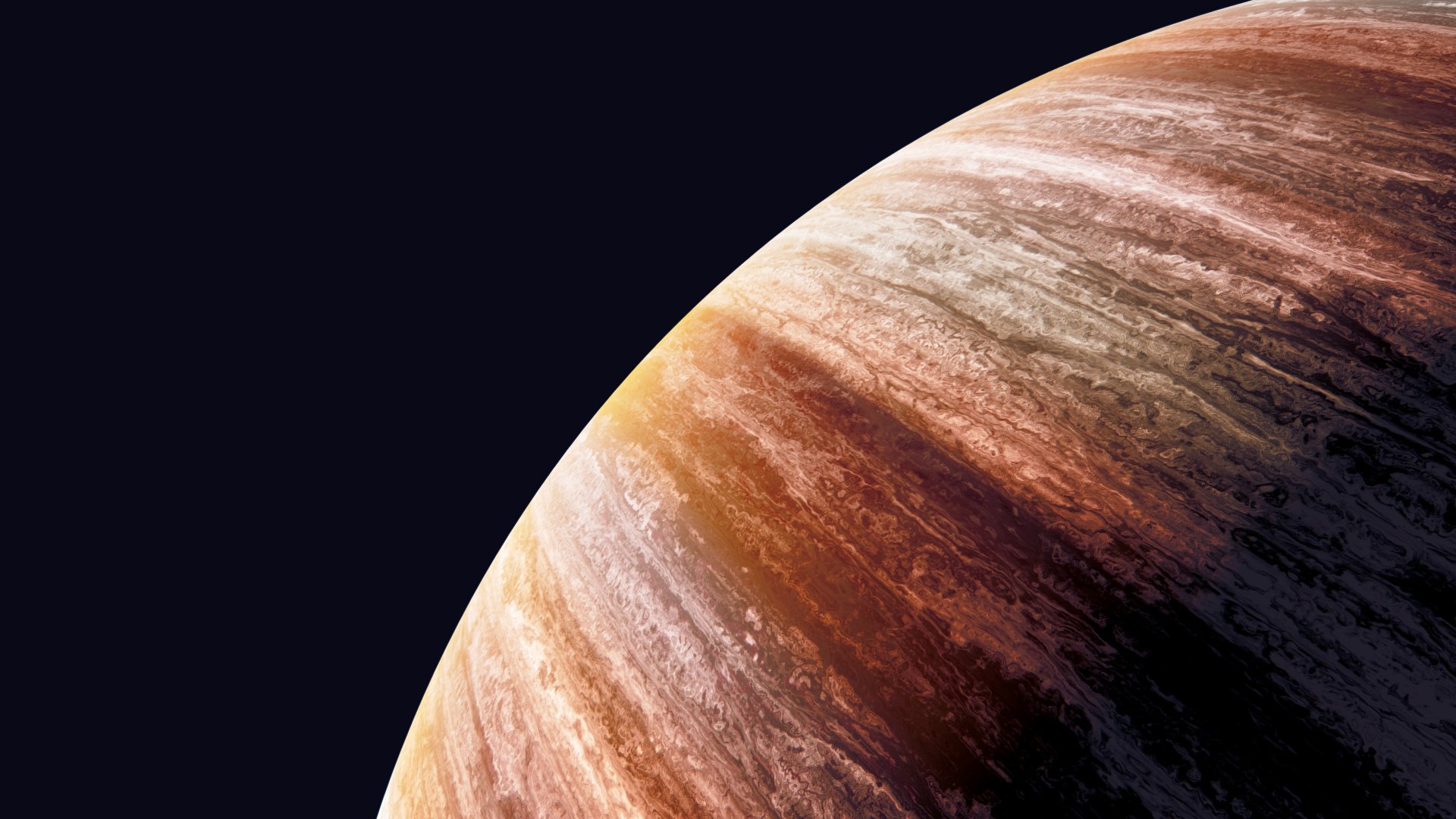
gasgiant_02
For gas planets I usually use distorted ramps with some Jupiter like colors.
Anonymous08/02/26(Sun)01:09:17 No.1031025
mojoworld
>>1029513
newfags dont know about mojoworld

grim

https://archive.org/details/mojoworld3
Anonymous08/16/26(Sun)23:34:23 No.1031457
>>1029513
I'm wondering this. I'm a blender expert but while blender does everything you could need for putting all the shit together, actually making a detailed and realistic (throwing random nose textures at the wall don't count) planetary terrain is beyond the scope of what blender can do, unless some super useful add on is flying under my nose.
Right now I'm experimenting with KTT for Houdini. In Houdini you can make second to none terrains, but translating this to a global map is the hard part.
Anonymous08/17/26(Mon)00:22:51 No.1031459
>>1031457
I come across many examples of great planetary maps on DA, but no one actually says how they make them. I'm also in JayChoken's Discord server but when I ask how he or others make their planet maps they never answer. His "planet making toolkit" video was also garbage.
Anonymous08/17/26(Mon)07:31:22 No.1031465
I guess it really depends on how realistic you want the whole thing to be. As someone above said, making it round is the problem. You could use something like world machine to generate terrain, or a bunch of noise modifiers and wrap it around the world, then use a 2nd uv set for the poles. You could then use a bunch of colour ramps on the heightmaps for oceans and mountaintops. Depending on what you use your kind of limited for the rest, biomes, terrain texturing, erosion things like that.
Anonymous08/17/26(Mon)17:24:40 No.1031482
>>1031025
thank you (oldfag) for introducing me (newfag) to mojoworld
Anonymous08/18/26(Tue)21:56:43 No.1031544
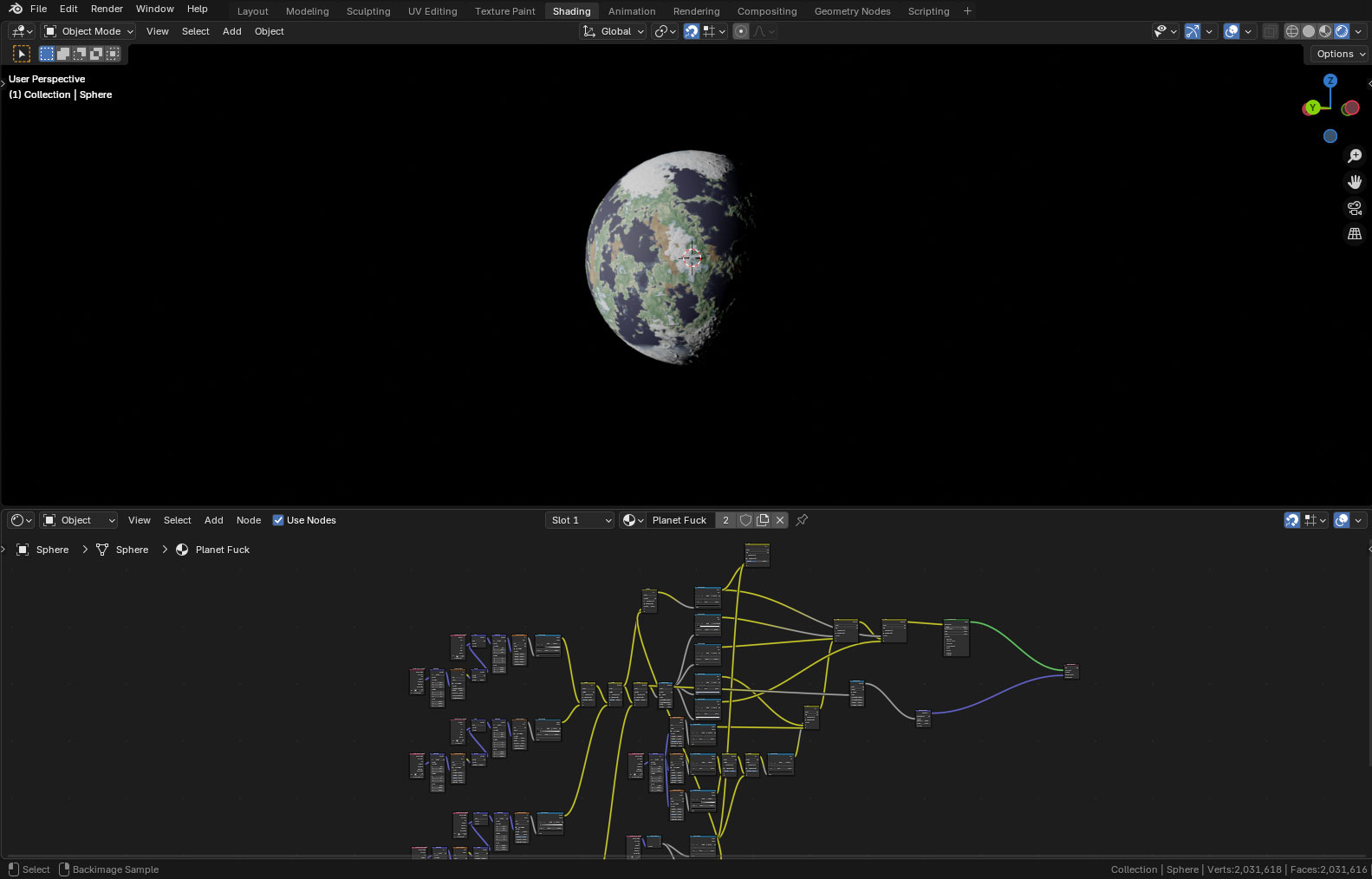
Planet-Fuck
I tried making a planet with shader nodes in blender. I don't really like it, i'm not sure what level of roughness a planet should have desu. It's just a bunch of noise textures used a displacement and then going colour ramp low (water) > mid (grass) > high (snow capped mountains)
Anonymous08/21/26(Fri)16:08:01 No.1031640
>>1031544
I dunno, I like it a lot. There seems to be enough control to get the beaches to show up where you want them. Once you add the atmosphere and a cloud layer, it will all blend together nicely. Don't do the clouds procedurally. This never works. The NASA page has a nice cloud layer that everyone uses.
Anonymous08/21/26(Fri)16:13:28 No.1031642
>>1031544
>what level of roughness a planet should have
At these scales completely rough and the oceans around 30%. The atmsphere adds another diffusion layer on top.
Anonymous10/10/26(Sat)08:31:54 No.1033419
Not to worry. I got sick of every "planet generator" being noise-driven crap. I'm making a software that does this properly with all the paramaters you will ever need if you are into planetary science on an autistic level. Stay tuned.
Anonymous10/10/26(Sat)10:02:08 No.1033423
>>1033419
ETA on release? And where can it be found?
I'm actually working on the same thing.
Anonymous10/10/26(Sat)10:05:37 No.1033424
>>1033423
Dunno, I'm vibeslopping it. I'll post it here when I make actual progress. I'd like to see where yours is at also since this seems really difficult.
Anonymous10/10/26(Sat)11:13:15 No.1033426
>>1033424
I'm vibeslopping mine. I would say the most difficult thing with an earthlike planet is that all large scale features are driven by plate tectonics.
Stagnant lid planets like Mercury or the Moon are easy to fake using noise because of their lack of plate tectonics, which on Earth drives mountain ranges and depressions in a way that doesn't look like noise.
If you can make a system that emulates both past and present plate activity on a planet then you are 90% of the way there. The lower level detail is all solved problems.
Anonymous10/10/26(Sat)11:33:50 No.1033427
>>1033426
Mercury and the Moon is 90% noise and craters, which are easy and cheap. But I still want to go further so I've proposed a plan that would allow us to generate deterministic planets with unique and "staple" albedo features like Mars' Valles Marineris or Iapetus' markings. I've messed around with SpaceEngine enough to know that stacking noise isn't enough to create convincing planets. Humans are really good at spotting patterns. Generating continents on a tectonic world is for sure more of a challenge and I'm not sure how I'm going to accomplish that yet. My final vision is to have a program that can take in any parameters for a planet, suggest feasible numbers for missing parameters and warn against "unfeasibility", and generate studio-ready planets of any kind. Both types within the Solar System and more exotic types like temperate desert worlds (e.g. Arrakis), snowball worlds (e.g. Hoth), exo-Titans, eyeball worlds etc. and basically any hypothetical terrestrial. It will also run a climate sim and generate realistic cloud maps, split into layers among other things I don't know are possible to achieve with current AIs. Maybe I have to wait for Fable 5.5 for this. We'll see how it turns out. I'd like to tackle giant planet textures too as well as in-betweens which are more hypothetical. They are more of a solved problem, but I want a program that produces physically plausible results based on a set of input parameters, and then lets you freely tweak results in an artistic pass if you wish, rather than just "run a fluid sim on a RNG colour palette".