← /an/

Measuring hen pain

New launches split creator fees 50% to the poster and 50% to the launcher. No tripcode is needed to launch; poster claims require verified ownership.

Anonymous11/24/26(Tue)15:12:39 No.5177113
IMG_0080
I read this article about the amounts and intensities of egg laying chicken suffering in farms. Is he right or is he just making stuff up?

What’s the most painful thing that ever happened to you? Seriously take a moment and contemplate it, try, in as much detail as you can, to remember what it was like. Maybe, for a few of you it was childbirth, an experience which, when it takes place without anesthesia, is temporarily completely debilitating. Nothing other than the pain occupies the mind of the sufferer.

Perhaps it was getting a tattoo. Someone on Quora summarized the pain of getting a tattoo in the following way:

>They hurt.

>There are between one and 20 needles being poked through your skin hundreds of thousands of time in a single session. The number of needles will determine the type and intensity of pain. So expect it. The real question is how much will it hurt.

I’ve been quite lucky and never experienced any particularly severe pain. I can remember quite a few times I’ve had pretty intense pain, barely eating for two days, having a doctor press down on my infected finger until it popped when I was 8, having a very severe stomach ache, falling out of a treehouse (though remaining in the tree) and banging my chin on the side of it, but nothing has been that bad. I’d guess the worst experience of my life is a lot less painful than a wrist tattoo.

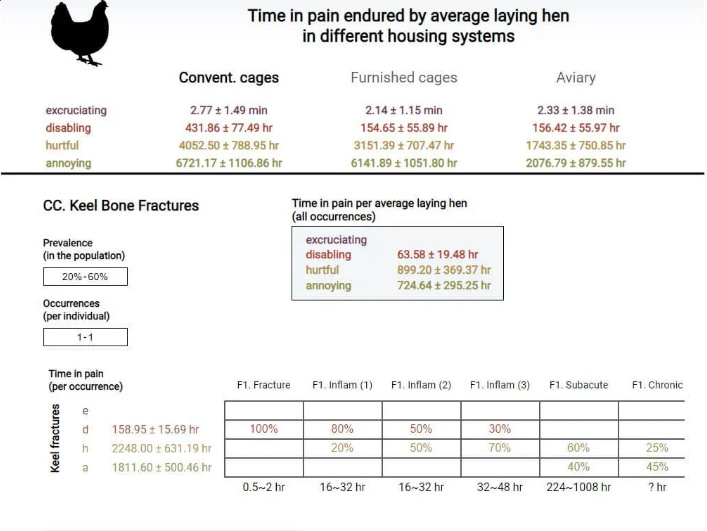
The most painful experience that most of us have ever had is classified as disabling pain. This is the sort of pain that’s bad enough that during it you can’t enjoy doing anything else, you can’t, for instance, enjoy a game of chess while giving birth, and that makes it impossible to focus on anything other than the pain. Examples of this kind of pain include a very painful fall, breaking a bone, burning yourself, giving birth, severe dog bites, getting a tattoo, kidney stones, and hemorrhoids.
Anonymous11/24/26(Tue)15:13:51 No.5177114
https://welfarefootprint.org/species/laying-hens#book

https://cp.pain-track.org/hens


>>5177113
While we often forget about these later, when they’re happening, they feel like the most significant thing in the world. They’re extremely bad, if you offered me $1,000 to get severely bitten by a dog, its teeth ripping off a chunk of my flesh, or have needles pierce my skin hundreds of times, I wouldn’t take the deal. Certainly I wouldn’t undergo childbirth for 1,000 dollars, especially if it was without anesthetic

Sadly, on average, the animals that we eat endure hundreds of hours of this kind of debilitating agony over the course of their life. They endure somewhere on the order of an hour a day of this pain.

I’ll just discuss one such case, the case of the egg-laying hen, with the facts gathered from this report. https://welfarefootprint.org/laying-hens/
Anonymous11/24/26(Tue)15:14:58 No.5177115
>>5177114
Productivity gains in the egg industry have stemmed predominantly from the selection of highly productive breeds, along with the manufacturing of highly specialized diets and additives designed to maximize feed conversion. Commercial layer lines now lay about 320 eggs over a period of 70-80 weeks, compared to about 80 eggs per year in 1900. The industry’s goal goes further, as it aims to reach an average production of 500 eggs per laying hen in about 100 weeks.

In addition to massive increases in output per animal within a few decades, major shifts in raising methods included the confinement of animals at high densities in closed and barren environments. In the case of laying hens, confinement has reached extreme levels through the adoption of cage systems (also known as battery cages). This system restricts hens’ space provided to approximately 430 to 450 cm2 per bird, an area smaller than an A4 sheet of paper. As of 2021, most laying hens still spend their entire lives in these cages.

Extreme confinement and over-selection for early, elevated and extended egg production takes a heavy toll on the health of laying hens, with a high incidence of metabolic and bone disorders, among other physical and psychological challenges associated with acute and chronic pain.

In this project, we apply our analytical framework https://welfarefootprint.org/analytical-approach/ to quantify the welfare impact of cage-free reforms, as measured by the cumulative time in pain (i.e. affective states of negative valence) potentially averted for every laying hen raised in an aviary instead of a cage.
Anonymous11/24/26(Tue)15:16:01 No.5177116
>>5177115
Our analysis focuses on conventional cages, furnished cages and indoor aviary systems (single-tier and multi-tier), considered by the industry as the preferred cage-free alternative for large scale egg production. For each housing system, we estimated the total time an average laying hen spends in different categories of pain intensity based on the intensity and duration of the pain endured from key welfare harms and their typical prevalence in commercial flocks. In all cases, the analysis is focused on the laying phase, which was assumed to last 40 to 60 weeks (hence the assumed lifespan, considering a pre-laying phase of about 20 weeks, is approximately 60 to 80 weeks for all systems).

Instead of considering an exhaustive list of every possible harm affecting commercial layers, we examined key sources of physical and psychological pain arising from the most serious welfare problems, particularly those likely to be affected by the transition from cages to cage-free aviaries. Among these are keel bone fractures, injurious pecking (e.g. skin wounds, vent wounds, cannibalism), the deprivation of a number of highly motivated behaviors and egg peritonitis syndrome (the most common production disease in modern breeds of laying hens and the leading cause of mortality). We also quantify the cumulative time in pain resulting from the process of depopulation and transport, as it remains one of the most serious welfare problems in the poultry industry. Estimates of time in pain should be therefore viewed as the minimum time in pain endured by laying hens, during the laying phase, in the different systems analysed.
Anonymous11/24/26(Tue)15:17:05 No.5177117
>>5177116
DEFINITIONS

ANNOYING PAIN

Experiences of pain perceived as aversive, but not intense enough to disrupt the animal’s routine in a way that alters adaptive functioning or affects the behaviors that animals are motivated to perform. Similarly, Annoying pain should not deter individuals from enjoying pleasant experiences with no short-term function (e.g., play) and positive social interactions. Sufferers can ignore this sensation most of the time. Performance of cognitive tasks demanding attention are either not affected or only mildly affected. Physiological departures from expected baseline values are not expected to be present. Vocalizations and other overt expressions of pain should not be observed.
Anonymous11/24/26(Tue)15:18:28 No.5177118
IMG_0444
>>5177117
HURTFUL PAIN

Experiences of pain in this category disrupt the ability of individuals to function optimally. Different from Annoying pain, the ability to draw attention away from the sensation of pain is reduced: awareness of pain is likely to be present most of the time, interspersed by brief periods during which pain can be ignored depending on the level of distraction provided by other activities. Individuals can still conduct routine activities that are important in the short-term (e.g. eating, foraging) and perform cognitively demanding tasks, but an impairment in their ability or motivation to do so is likely to be observed. Although animals may still engage in behaviors they are strongly motivated to perform (i.e., exploratory, comfort, sexual, and maintenance behaviors), their frequency or duration is likely to be reduced. Engagement in positive activities with no immediate benefits (e.g., play in piglets, dustbathing in chickens) is not expected. Reduced alertness and inattention to ongoing stimuli may be present. The effect of (effective) drugs (e.g., analgesics if the pain is physical, psychotropic drugs in the case of psychological pain) in the alleviation of symptoms is expected.
Anonymous11/24/26(Tue)15:19:42 No.5177119
IMG_3401
>>5177118
DISABLING PAIN

Pain at this level takes priority over most bids for behavioral execution and prevents all forms of enjoyment or positive welfare. Pain is continuously distressing. Individuals affected by harms in this category often change their activity levels drastically (the degree of disruption in the ability of an organism to function optimally should not be confused with the overt expression of pain behaviors, which is less likely in prey species). Inattention and unresponsiveness to ongoing stimuli and surroundings are likely to be observed. Relief often requires higher drug dosages or more powerful drugs. The term Disabling refers to the disability caused by ‘pain’, not to any structural disability.
Anonymous11/24/26(Tue)15:20:46 No.5177120
>>5177119
EXCRUCIATING PAIN

All conditions and events associated with extreme levels of pain that are not normally tolerated even if only for a few seconds. In humans, it would mark the threshold of pain under which many people choose to take their lives rather than endure the pain. This is the case, for example, of scalding and severe burning events. Behavioral patterns associated with experiences in this category may include loud screaming, involuntary shaking, extreme muscle tension, or extreme restlessness. Another criterion is the manifestation of behaviors that individuals would strongly refrain from displaying under normal circumstances, as they threaten body integrity (e.g. running into hazardous areas or exposing oneself to sources of danger, such as predators, as a result of pain or of attempts to alleviate it). The attribution of conditions to this level must therefore be done cautiously. Concealment of pain is not possible.
Anonymous11/24/26(Tue)15:21:47 No.5177121
>>5177120
AVERAGE LAYING HEN

Although pain inherently concerns individuals, we operationally accept that the collective welfare of the members of a population can also be determined. Measuring cumulative pain at the population level is also necessary to account for the heterogeneity in the exposure of population members to different challenges. For example, while lameness is experienced by a large fraction of broiler chickens, fatal cases of ascites are only experienced by a few. Therefore, measurement efforts must consider the prevalence of each welfare challenge, so that pain is determined for the average member of the population (which may not necessarily correspond to any real organism). At the population level, the time spent at each level of pain intensity as a result of each challenge is determined by multiplying it by its prevalence. For example, if a condition causes 10 hours of Disabling pain and 70% of the population are affected, then the average member of this population could be said to experience 7 hours of Disabling pain due to the condition. Measurements at the population level enable comparing the impact of different practices and conditions across demographics, geographies, and time.
Anonymous11/24/26(Tue)15:22:49 No.5177122
>>5177121
MAIN FINDINGS

Cage-free aviaries were found to be clearly superior to conventional cages and furnished cages even soon after a transition to cage-free environments. Overall, an average of at least 275 hours of disabling pain, 2,313 hours of hurtful pain and 4,645 hours of annoying pain are prevented for each hen kept in an aviary instead of CC during her laying life, and 1,410 hours of hurtful pain and 4,065 hours of annoying pain prevented for each hen kept in an aviary instead of a FC during her laying life.

The longer time in pain in caged systems stems predominantly from the deprivation of highly motivated behaviors;

Most pain endured in cage-free production results from ailments associated with intense breeding for productivity;

Keel bone fractures are the most important welfare concern in cage-free aviaries;

The time in pain due to the direct physical consequences of injurious pecking (skin and vent wounds, cannibalism, pain from feather removal) was substantially lower than that resulting from other challenges (the analysis, however, does not consider potentially higher levels of fearfulness as a consequences of injurious pecking or the discomfort from plumage damage);

Approximately 2,000 hours of excruciating pain are expected for every flock of 50,000 laying hens (1-3 hours per individual affected)

Egg peritonitis syndrome, a production disease kept out of the research scope, was the main source of intense pain in all systems given its possible evolution to sepsis and the chronic nature of the pain endured by many of those hens surviving the disease
Anonymous11/24/26(Tue)15:23:52 No.5177123
>>5177122
WHY ESTIMATES OF THE BENEFITS OF CAGE-FREE AVIARIES ARE CONSERVATIVE

The analysis primarily aimed to estimate the minimum welfare improvement associated with transitioning to cage-free housing. In this sense, we preferred to err on the side of caution than potentially overestimated reform benefits in any particular aspect. Thus, it is reasonable to anticipate that the actual benefits of this transition may surpass the estimates. This expectation is supported by the following factors

The analyses assume the same lifespan for all systems, but hens in cages have a potentially longer lifecycle, with the last weeks of life being particularly challenging. For example, in many countries outside Europe producers may still subject hens to a practice known as “induced molting” to extend their productive life. This is achieved by withdrawing their feed for several days (e.g., in the US 60–80% of caged layers are molted compared to <15% in cage-free production)

The estimates are based on the prevalence of key welfare conditions during laying as reported for commercial settings. They reflect a situation where the technological, genetic and managerial maturity of cage-free housing is not yet on par with that already achieved by caged systems; as producers acquire more experience and genetics are optimized to cage-free environments, the welfare benefits are expected to be even higher;
Anonymous11/24/26(Tue)15:25:54 No.5177124
>>5177123
We did not consider the welfare impacts of the perception of lack of control in cages. A sense of control over adverse conditions has been shown to be one of the most critical components of mental well-being, both in humans and animals. Animals unable to escape aversive conditions are known to develop severe emotional distress in the form of helplessness, a depressive-like state. Caged hens are virtually prohibited from expressing any form of agency, motivated behaviors, to distance themselves from cage mates, resolve conflicts or adopt postures needed for comfort and thermoregulation. Often, they are kept in extremely low light intensity, compounding this effect

Lack of control can also potentiate fear. Fear can be extremely damaging if intense or persistent. Confinement in cages can generate a sustained state of fear as a result of helplessness and deprivation. Where differences are present, hens have been shown to be more fearful in cages.

Positive states, other than eating and drinking, are very much limited in cages, hence preventing any type of compensation for the negative states endured
We did not analyze the rearing phase. Should caged hens be reared in cages too, the challenges emerging from confinement at this younger age would add to the estimated time in pain in cages;

We have considered a higher prevalence of keel bone fractures in cage-free systems. However, studies of the prevalence of keel fractures in cage-free settings using more precise methods (dissection) that typically lead to a higher prevalence. Additionally, a recent review highlights that the link between housing system and keel bone fracture prevalence may not be supported.
Anonymous11/24/26(Tue)15:26:56 No.5177125
>>5177124
PAIN-TRACKS AND SENSITIVITY OF THE ESTIMATES

All parameter values used for the analysis (estimates of duration, intensity, number of occurrences and the prevalence of each welfare offense) are justified in the book “Quantifying Pain in Laying Hens” (see below). https://welfarefootprint.org/book-laying-hens/ However, we invite the reader to examine the extent to which the estimates presented here are sensitive to our choices and assumptions, at the platform https://pain-track.org/hens In this web application, all parameter values can be altered, with the immediate update of all estimates.
Anonymous11/24/26(Tue)15:28:00 No.5177126
>>5177125
RESEARCH GAPS

The need to quantify the intensity and duration of the pain emerging from multiple injuries, diseases, and deprivations has highlighted different research areas where knowledge is still lacking, detailed in the book. Surprisingly little research has been dedicated to the understanding of the impact of different welfare challenges at the individual level (where suffering occurs). Little is known about clinical evolution of the various welfare issues affecting commercial layers (e.g. healing times, duration of exposure), the likelihood of different clinical outcomes, rates of recurrence, and how adversely welfare harms are perceived by the individuals affected. Similarly, knowledge on case-fatality rates, comorbidity patterns and the prevalence of different conditions over the laying cycle is scant.

Longitudinal studies targeting individual birds in commercial conditions are very much needed. They can help understand (1) the extent to which each welfare harm disrupts the routine and behavior of the individuals affected, hence helping establish the degree to which conditions are perceived as aversive; (2) the recurrence of harms (how many wounds, attacks, fractures, or disease episodes an individual animal endures over the laying cycle); (3) the temporal evolution of each harm, including fatal conditions; (4) the rates of spontaneous healing in the case of injuries and diseases; (5) patterns of comorbidity and (6) the extent to which behavioral opportunities are realized in cage-free settings, and how this changes over time.
Anonymous11/24/26(Tue)15:29:01 No.5177127
Table of Contents

All chapters freely available in PDF format:

Chapter 1. The Comparative Measurement of Animal Welfare: the Cumulative Pain Framework. https://drive.google.com/file/d/1dg7emvh4EAOS9h9Yij-pH6-U_aVGieLO/view?usp=sharing

Chapter 2. The Life of Commercial Laying Hens https://drive.google.com/file/d/1zeTH9bEK_s9JmO2W_bKO_BL9A81p05Ny/view?usp=sharing

Chapter 3. The Burden of Pain due to Keel Bone Fractures in Laying Hens https://drive.google.com/file/d/1yI7z9_rOoPJzfiodkkwq8l95fOIViejP/view?usp=sharing

Chapter 4. Welfare Implications of Injurious Pecking in Laying Hens https://drive.google.com/file/d/152XLpZDegfXFrBlpD1ZniPUyQwg7QCb-/view?usp=sharing

Chapter 5. Egg Peritonitis Syndrome, a Painful and Prevalent Disease in Commercial Layers https://drive.google.com/file/d/18x315ZWco448FF5T_FqGBz-UNhKFlDVd/view?usp=sharing

Chapter 6. The Burden of Psychological Pain in Laying Hens: behavioral deprivation https://drive.google.com/file/d/1JWZElTIe3PtkJaISZU9Sj_MUzjWl1Nf6/view?usp=sharing

Chapter 7. The Last Day of a Hen’s Life: depopulation and transport https://drive.google.com/file/d/1mo49dbeLEa-YRdV2sCDcnzP4JIhfJZSL/view?usp=sharing

Chapter 8. Prevalence of Welfare Harms affecting Commercial Layers in Different Housing Systems https://drive.google.com/file/d/1bHNUYGcBNzPJNLzIIPNSKzKs3Uz9fiuE/view?usp=sharing

Chapter 9. Impact of the Transition from Caged to Cage-free Housing on the Welfare of Laying Hens https://drive.google.com/file/d/1he5hQ_2VmLKUdsBqEPU5yeneOTCbGoAs/view?usp=sharing

Acknowledgments https://drive.google.com/file/d/1Orw_ung5cmxaVHncJJWzSr-_oRFUt_R3/view?usp=sharing
Anonymous11/24/26(Tue)15:30:06 No.5177128
IMG_3593
Anonymous11/24/26(Tue)15:31:10 No.5177129
IMG_3594
Anonymous11/24/26(Tue)15:32:13 No.5177130
IMG_3595
>>5177114
Egg-laying hens in conventional farms endure about 400 hours (!!!!!) of this kind of disabling agony. Remember, this is agony about as bad as the worst thing that’s ever happened to you, unless you’ve had an experience as bad as being severely tortured. This is the agony that makes it impossible to think of anything else. The hens endure about an hour of a day of this extremely intense agony.

This intense pain comes from many sources including (this list is non-exhaustive):

Bone fractures.

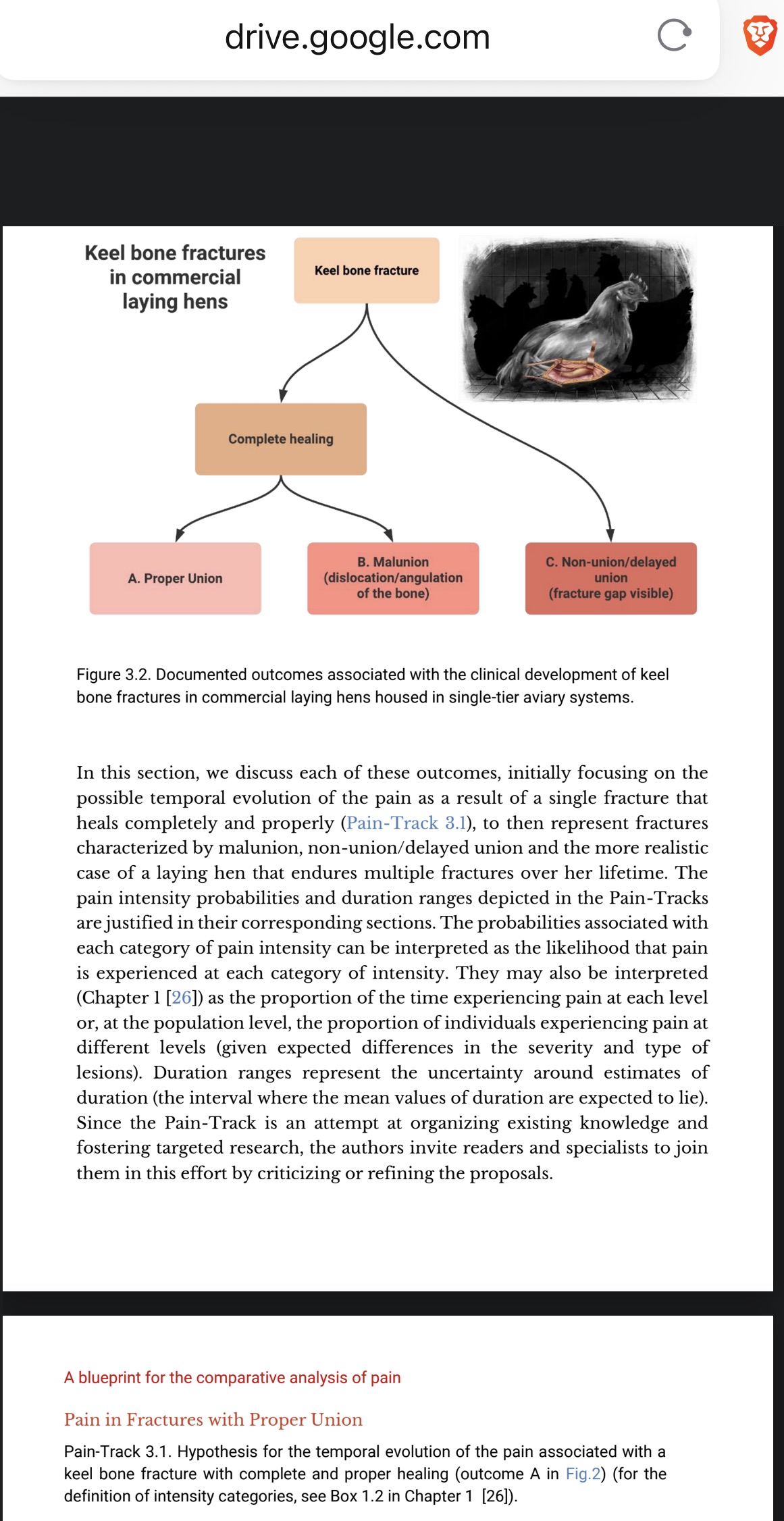
The majority of hens experience a bone fracture over the course of their life. On average, they have three. Imagine if you broke the same bone three times This is, and I can’t emphasize this enough, what most hens deal with the industry that produces our eggs is so cruel that it breaks the bones of most hens multiple times.

In fact, the situation is much worse for hens than it would be for us because the area around their keel bone, which is the most common kind of fracture, has a huge number of nerves. While such experiences in humans usually produce disabling pain for about a day, for chickens, such pain lasts about a week

Often the bone doesn’t heal properly, leading to constant intense agony
Anonymous11/24/26(Tue)15:33:16 No.5177131
>>5177130
Injurious pecking.

In a hen's natural environment, she’ll spend most of her time pecking the ground looking for food. In a modern farm, hens can’t do that, so they spend a lot of their time pecking other hens, often leading to severe injury (just imagine that you were being bitten all the time by people surrounding you). It’s not terribly uncommon for hens to be pecked to death (seriously imagine what it would be like for that to happen) or for pecking to affect a hen’s body part known as the vent which is particularly sensitive (in this case, for the males reading this, imagine someone biting your balls). Often this becomes infected.

Every one of a hen’s natural behaviors are thoroughly squashed in the farms. Hens cannot make a nest prior to laying an egg, which causes them quite severe distress. Hens are willing to undergo strong electric shocks in order to get a suitable nest, about as strong as the electric shocks they’ll endure in order to get food after being starved for 28 hours (!!!!!). Remember, hens lay an egg roughly daily! This may not seem like a big deal, but only because we don’t appreciate the experience of being a nesting hen; an alien wouldn’t understand why we care about sex so much. Konrad Lorenz, a nobel prize winner summarized:

>“The worst torture to which a battery hen is exposed is the inability to retire somewhere for the laying act. For the person who knows something about animals it is truly heart-rending to watch how a chicken tries again and again to crawl beneath her fellow-cage mates to search there in vain for cover”
Anonymous11/24/26(Tue)15:34:19 No.5177132
>>5177131
Whenever you purchase a few cartons of eggs, you are consigning a chicken to living in these horrifying, excruciating conditions. Before you next purchase eggs, or chicken, or most any other animal product, though eggs are likely the worst, remember what the worst experience of your life is like, and vividly consider the fact that your purchase will likely cause others to endure many hours of an experience just as bad.
Tragically, the true scenario is much worse than that. Even worse than these scenarios of intense yet bearable pain are experiences that the authors of the report call excruciating pain. This is the sort of pain experienced when a person is brutally tortured or slowly eaten alive or burned to death for minutes; the sorts of pain that, if you’re really brave, you can read about in some detail here. https://www.simonknutsson.com/the-seriousness-of-suffering-supplement They’re horrible enough to take on an almost qualitatively different dimension, something most of us wouldn’t trade for many decades of happy life. This kind of pain is literally inconceivable, it’s so bad that many people who experience it attempt suicide. A hen might experience this right as she’s being trampled and pecked to death.
Hens experience, on average, about two and a half minutes of this horrifying agony. The hundreds of hens that the average person eats over the course of their life (and yes, your consumption of eggs does cause more hens to be brought into existence, mistreated, and killed) mean that the average person is probably causing several hours of this unfathomable agony, the sort of agony one experiences in the minutes that they die from burning, boiling, being eaten alive, or suffocating to death; the kind of agony worse than being mauled by a dog, worse than childbirth, worse by orders of magnitude than anything you’ve ever experienced
Anonymous11/24/26(Tue)15:34:20 No.5177133
>>5177113
Interesting. Going to have a roast chicken tonight. Thanks.
Canola oil is disgusting trash btw.
Anonymous11/24/26(Tue)15:36:29 No.5177134
>>5177132
The kind of experience that, to take a contemporary example, George Floyd probably experienced for the minutes that he was suffocating. (Fentanyl)
The average meat eater causes hours of that!
This is why factory farming is such a great moral emergency. It’s the cause of agony beyond what we could hope to imagine. Amounts we cannot fathom of agony that we cannot fathom. It’s not just egg-laying hens that experience this; it’s ubiquitous in the entire factory farming industry. As Ren says in an https://forum.effectivealtruism.org/posts/xtcgsLA2G8bn8vj99/reminding-myself-just-how-awful-pain-can-get-plus-an#Miscellaneous_thoughts_and_takeaways article that’s very worth reading, describing her own experience with fairly intense pain:
A single broiler chicken experiences fifty hoursof

https://www.pain-track.org/broilers
[disabiling] pain during their lifespan, which lasts 4-6 weeks. There are 69 billion broilersslaughtered each year. That is so many hours of pain that if you divided those hours among humanity, each human would experience about 400 hours (2.5 weeks) of disabling pain every year. Can you imagine if instead of getting, say, your regular fortnight vacation from work or study, you experienced disabling-level pain for a whole 2.5 weeks? And if every human on the planet - me, you, my friends and family and colleagues and the people living in every single country - had that same experience every year?

How hard would I work in order to avert suffering that urgent?

>>5177133
It’s healthier than butter and other animal based sources of fat which are too high in saturated fat.
Anonymous11/24/26(Tue)15:39:30 No.5177135
imagine being this insufferable of a faggot. we should just eliminate all chickens so they’ll never have to feel pain again. good?
Anonymous11/24/26(Tue)15:41:06 No.5177136
>>5177135
That’d be preferable to the status quo yes, ideally also ducks so they aren’t used as replacement in factory farms
Anonymous11/24/26(Tue)19:05:01 No.5177165
Illegal quails guy here do quails also feel pain laying eggs? Cuz I dont want them to
Anonymous11/24/26(Tue)20:05:56 No.5177172
>>5177165
Vegan animal sanctuaries give chicken hens a medication or implant to prevent them from laying eggs to prevent things like osteoporosis and stuck eggs but they have been selectively bred to lay too many eggs too often.
Anonymous11/25/26(Wed)00:19:23 No.5177190
Not an argument for veganism

Just an argument for breaking up large factory farms into many feedlot operations that use the same amount of resources besides non-arable land, of which we have plenty, and human labor, which we need to utilize more to avoid the collapse of society.

And not for the sake of the chickens, but for the sake of the distressed human workers and the losses we incur when cramped flocks have to be culled or are full of diseased and damaged meat.

The chickens have no moral relevance.

>>5177172
Being vegan for ethical reasons is ontologically evil. They could spend those resources on homeless humans instead of lower animals or semi-wild hominoids.

Prioritize your in-group or be a threat to it - and then die.

>but trait equalized... name the trait
The trait is self evident. You will make the correct distinction between human and chicken, chicken and dog, dog and human, etc, or there will come a time when people like you will be punished accordingly for the threat you pose to mass human well being.

No society has ever successfully restricted meat intake without the lower classes suffering oppression on the biological level.
Prioritize your own species or leave it. This is not an argument. This is a threat.
Anonymous11/25/26(Wed)05:04:34 No.5177211
>MOM! IT'S BEEN 30 FUCKING MINUTES! WHERE'S MY GODDAMN TENDIES?!
Anonymous11/25/26(Wed)05:18:31 No.5177213
Anonymous11/25/26(Wed)05:26:32 No.5177214
I got chronic kidney stones so you could say I'm an honorary hen, I also got a few in my backyard and they don't make too much of a fuzz when laying.
Anonymous11/25/26(Wed)07:42:34 No.5177233
>>5177172
That's cool
Anonymous11/25/26(Wed)11:53:50 No.5177263
>>5177190
>Being vegan for ethical reasons is ontologically evil.
>The chickens have no moral relevance.

Yet every time a poll or ballot referendum is done most normies say or vote to support more humane conditions for farm animals. Most people support improving the lives and feelings of farm animals even when there’s zero benefit to humans and actually a small cost to humans such as a few weeks ago two places in the United States banning the cruel ( Washington, D.C., and Denver both voted to ban foie gras (from force-fed birds) on November 3, 2026.) by 67% and 73% or jury nullification for people breaking into a factory farm to rescue piglets

This man was ON VIDEO RECORDING HIMSELF COMMITTING HIS CRIME And he was COMPLETELY ACQUITTED BY A JURY of breaking into a factory farm to rescue two sick piglets despite overwhelming evidence that he did it. They literally filmed themselves committing their “crimes” and confessed but were still acquitted. Before he went to trial his own attorney begged him to take a plea deal and plead guilty to reduce the amount of jail time he’d get when he was found guilty at trial but he went to trial instead and was found not guilty and got no jail time or punishment.

This
https://m.youtube.com/watch?v=_7q87fAYbZk 4 minutes and 30 seconds in you can see live footage from courtroom of the not guilty verdict being read.

The animal rescue took place in March 2017 at Smithfield Foods' Circle Four Farms in Beaver County, Utah, and the trial was held in neighboring Washington County, Utah in October 2022.

Beaver County is extremely rural, heavily agricultural, and politically conservative. In political elections, both Beaver County and Washington County voted overwhelmingly for Donald Trump (winning roughly 80% and 70% of the vote, respectively).

Pregnant pigs were locked inside 2 by 7 foot metal gestation and farrowing crates, spaces so narrow the animals could not turn around.
Anonymous11/25/26(Wed)11:56:24 No.5177265
>>5177214
The article never even implies backyard hens live mostly bad lives (more suffering than well-being). The laying egg isn’t that painful as long as there’s no complications like a stuck egg requiring veterinary care or osteoporosis
Anonymous11/25/26(Wed)13:24:38 No.5177280
>72% of the text on this page was almost certainly written or edited by generative AI
thread hidden
Anonymous11/25/26(Wed)16:53:52 No.5177307
7644666
>>5177280
I had to cut a chunk out of beginning, middle and end because I only had 20 credits but the only ai is the two short paragraphs about the jury trial
Anonymous11/26/26(Thu)03:12:44 No.5177363
the big mistake (in welfare terms) seems to be breeding chickens into complete genetic mostrosities that live with chronic pain and often experience severe injury even when not confined in tiny cages
but how do you regulate that? we can't even get people to stop buying pugs
Anonymous11/26/26(Thu)10:57:55 No.5177434
IMG_3621
>>5177363
It’s both tiny crowded cages and genetics. This thread was about egg laying hens but the true genetic franksteins are the meat breed chickens not the egg breeds

They also wrote a free book about the meat breed broilers https://pain-track.org/broilers

https://welfarefootprint.org/broilers
Anonymous11/26/26(Thu)11:03:29 No.5177436
>>5177363
No European country has fully enacted a legal ban on specific chicken breeds for growing too fast (broilers) or laying too many eggs (layers). Action is concentrated on fast-growing meat chickens (“turbo chickens” or “frankenchickens,” mainly the Ross 308 and similar lines), driven by welfare concerns such as lameness, heart/organ strain, and mobility problems from rapid growth (often to ~2 kg in ~33–35 days)

About 95% of EU broilers are fast-growing.

Netherlands: In September 2026 the government proposed phasing out the rearing of fast-growing breeds (those whose genetics impair natural movement) by 2040 as part of a"dignified livestock" draft regulation. The proposal is before parliament (expected debate/vote around 2027). Fresh supermarket chicken is already essentially 100% slower-growing higher-welfare birds (Better Life 1-star standard from retailer pressure and campaigns). Roughly 40% of Dutch production is now slower-growing, though conventional birds continue for processed products, foodservice, and export

Norway (European but not EU): The poultry industry (including major player Nortura) has a voluntary commitment to fully phase out fast-growing breeds such as Ross 308 by the end of 2027. It is the first country to commit to complete elimination.
Anonymous11/26/26(Thu)13:11:49 No.5177460
IMG_2051
>>5177113
Chickens should be replaced with these
Anonymous11/26/26(Thu)13:48:39 No.5177465
>>5177460
Thats sorta happening with the new lab grown chicken meat. Sorta, since its just cells
Anonymous11/26/26(Thu)17:03:37 No.5177487
>>5177460
>>5177465
Never had a mind = never had a soul = no rights violation
Anonymous11/26/26(Thu)17:30:49 No.5177490
>>5177113
Tl;dr
Does the breed and size of the bird play a factor in this pain or fractures?
Anonymous11/26/26(Thu)17:32:21 No.5177491
>>5177490
For meat breed yes massively, for egg laying hens only a little bit. Egg laying breed can survive in wild meat breed cant
Anonymous11/26/26(Thu)17:34:06 No.5177493
>>5177490
Egg laying breed can still develop osteoporosis from laying too many eggs too often this can be mitigated with birth control to prevent periods or feeding eggs back to hen to give back calcium in shell
Anonymous11/26/26(Thu)17:37:15 No.5177494
>>5177491
>wild meat breed cant
Idk about that, naked necks are tough cookies.
>>5177493
I already give them their shells back so this isn't a problem.
Anonymous11/26/26(Thu)17:47:13 No.5177496
>>5177494
Almost all like 95+% of 8 billion+ meat chickens in usa are Cornish cross like ross 308 and cobb 500 . Even vegan animal sanctuaries have trouble keeping them alive after a few months

Naked necks are for meat AND eggs and are not in supermarkets or factory farms.
Anonymous11/26/26(Thu)19:13:59 No.5177504
>>5177496
Mine were never really good at lsying a lot of eggs. Maybe yours are different I don't know.
>Cornish cross
Now there's your problem. You can take a factory chicken out of the factory but don't expect it to live a long time. I never touched the factory chickens unless they're on a plate.
Anonymous11/26/26(Thu)19:18:01 No.5177505
bird
>>5177504
I don’t eat any chickens because I’m vegan
Anonymous11/26/26(Thu)21:21:48 No.5177515
>>5177505
What's your opinion on eating animals that die from natural causes?
Anonymous11/26/26(Thu)22:02:03 No.5177520
>>5177515
I see nothing wrong with it unless there’s extreme circumstances like it’s someone else’s pet they want to bury
Anonymous11/27/26(Fri)00:57:02 No.5177537
Why does this board attract so many schizos
Anonymous11/27/26(Fri)01:06:20 No.5177539
>>5177537
4chan attracts a normal number of schizos but unlike every other website it doesn't ban them. So it becomes a safe haven for schizos

And since humans don't like schizos, everyone who's not a schizo leaves. This results in wall-to-wall schizos with nobody else around
Anonymous11/27/26(Fri)13:10:43 No.5177612
Anya4chan
>>5177520
Nice. I'm planning on doing it with my dog.
Anonymous11/27/26(Fri)14:21:43 No.5177630
>>5177612
Look into organ / tissue donation
Anonymous11/27/26(Fri)16:00:05 No.5177649
>>5177630
I'm already an organ donor. It's on my id card.
Anonymous11/27/26(Fri)16:19:47 No.5177651
>>5177113
>the natural act of birth is a cruelty
Tranny argument
Anonymous11/28/26(Sat)02:25:37 No.5177725
>>5177263
This is AI non-logic.
>oversocialized normies react poorly to animal torture
>thereore starve yourself
normies killed chickens in their backyard for thousands of years
every society that has so much as restricted meat has seen malnutrition along class lines
75% of vegans fail
and your morals are irrelevant and nonfunctional in reality. an appeal to souls without a god.
Anonymous11/28/26(Sat)10:59:08 No.5177797
>>5177725
In Denver Colorado ordanice 309 in nov 2024 36% of voters voted to ban slaughterhouses in the city and 64% voted no, killing a chicken in your backyard 1000 years ago is not the same as torturing them for months in a factory farm then killing them.

All Eastern Orthodox are vegan for at least half the year. Eastern orthodox monks and nuns eat no meat year round.

That 2014 study does not control for people who went “vegan” or vegetarian only for health reasons.

There’s examples of mostly plant based societies without widespread class based malnutrition like in mesoamerica

58 percent of former vegetarians /vegans said health was there only or main reason for adopting the diet, only 29 percent said animal protection /ethics as a motivation
over half 53 percent, of those who quit did so within the first year

People who are vegan for ethical reasons and have been vegan for at least one year do not have a 75 percent rate of “failure” it is much much much lower than 75 percent for them

The study shows people who did it for ethical reasons were much less likely to “fail”

You can absolutely believe in souls and moral realism while being an agnostic or atheist and many professional philosophers do.
Anonymous11/28/26(Sat)13:21:31 No.5177815
vegetable
Anonymous11/28/26(Sat)13:44:32 No.5177819
Wow that's crazy OP but I'm not reading your reddit spaced geminislop
Anonymous11/28/26(Sat)13:47:45 No.5177822
>>5177797
>i believe in hampering human prosperity in the name of delusional beliefs
Also, your posts are AI generated and reposted slop. You are an idiot.

Societies that eat meat are smarter, taller, and longer lived on average. Being health focused and a meat eater is the ubermensch combination. Disregard studies that compare vegans that need to be nutri-nuts not to die with people who dont have to care or want to. The WEF just wants dumber cheaper slaves.
>earf could have 16 billion! think of the job growth, the gdp! -the actual thought behind the push for veganism
Anonymous11/28/26(Sat)13:49:02 No.5177824
>>5177815
Veganism is a pursuit for rich leeches who contribute nothing and have bullshit jobs like youtuber. Everywhere else in society they end up malnourished with no/stunted children.

Its like most religions in that regard. Oppressive to most who follow the example of the “brahmin”.
Anonymous11/28/26(Sat)13:51:19 No.5177825
Being vegan for ethical reasons is an implicit admission you would kill a human being to stop the slaughter of some number of cows.

Like its progenitor slave religion (hinduism) we are better off without its delusion-based definition of good. Veganism, hinduism, buddhism, and islam must be eradicated for the good of mankind.
Anonymous11/28/26(Sat)13:53:52 No.5177826
>>5177797
> There’s examples of mostly plant based societies without widespread class based malnutrition like in mesoamerica
The savage pagans with an average IQ of 80?
Anonymous11/28/26(Sat)14:06:07 No.5177831
>>5177797
Don't bother anon, that guy just keeps repeating the same baseless statements and strawmen no matter how much you prove them wrong. His entire goal is to waste your time
Anonymous11/28/26(Sat)14:07:52 No.5177832
>>5177797
>people dont want to smell an industrial slaughterhouse, so starve. You can either be vegan or eat ze slop.
This is literally non logic

Just convert industrial meat processing to multiple smaller scale farms idiot
State control of agriculture done
Anonymous11/28/26(Sat)14:14:58 No.5177835
>>5177822
There’s studies showing the vegan sect of the seventh day adventists are very healthy and live very long lives compared to meat eaters.

Studies looking at normal vegans of similar socio economic status to meat eaters show vegans are the only diet group not overweight according to
Bmi on average
Anonymous11/28/26(Sat)14:17:19 No.5177836
>>5177831
Yeah I am starting to see that when he keeps restarting from level 1 across threads copy pasting exact points I’ve already addressed

https://archive.4plebs.org/pol/thread/546273501/#q546283283

there is research supporting higher empathy (including toward humans) among vegetarians and vegans compared with omnivores

Filippi et al. (2010) The most frequently cited work is an fMRI study published in PLoS ONE titled “The Brain Functional Networks Associated to Human and Animal Suffering Differ among Omnivores, Vegetarians and Vegans” by Massimo Filippi and colleagues.

60 people matched for age and sex (20 omnivores, 19 vegetarians, 21 vegans). The vegetarians and vegans had chosen their diets for ethical reasons.
Self-reported empathy: Using the Empathy Quotient (EQ) questionnaire, vegetarians scored highest (mean ≈ 49.5), followed by vegans (≈ 44.6), with omnivores lowest (≈ 38.8). These differences were statistically significant.

Brain responses: Participants viewed negative-valence images of human and animal suffering (mutilations, threats, torture, wounds, etc.), alternating with neutral landscapes.

When viewing human suffering, vegetarians and vegans showed greater activation in the anterior cingulate cortex (ACC) and inferior frontal gyrus (IFG)—regions involved in empathy and emotional processing—compared with omnivores.

Responses to animal suffering were also stronger in the plant-based groups (and sometimes involved additional self-related areas), with reduced amygdala activation relative to omnivores.

The authors interpreted this as evidence that ethical vegetarians and vegans recruit empathy-related networks more strongly for both human and non-human suffering.
Anonymous11/28/26(Sat)14:18:21 No.5177839
>>5177836
Also a 2021 systematic review in Frontiers in Psychology (“Differences Between Omnivores and Vegetarians in Personality Profiles, Values, and Empathy”) examined 25 studies (total n ≈ 23,589). It concluded that vegetarianism is associated with greater openness and empathy, while omnivorism is linked to higher social dominance orientation and right-wing authoritarianism. Several included studies (e.g., Preylo & Arikawa, 2008) specifically measured human-directed empathy via the Interpersonal Reactivity Index and found higher scores (especially on empathic concern and perspective-taking) among vegetarians.
Anonymous11/28/26(Sat)15:15:09 No.5177858
>>5177835
>studies show people who have to pay attention to what they eat do
Socioeconomic is meaningless
You are an idiot on the firstmost principle
The concept is idiotic

>>5177836
Excessive empathy is a disorder
See: refugees welcome

Grow up and get over it
Prioritize yourself or be erased by those who do

Die out and be replaced by muslims, phil-idiot.
Anonymous11/28/26(Sat)15:17:01 No.5177860
>>5177839
>science shows I’m excessively, suicidally nice
You are dying out and being replaced by muslims. And no heaven awaits to reward you for your abstract morals. Only death.

Such is the reward of the philidiot. An inept self flagellating moron that virtue signals their people to death until all the remains is a disgraced, meaningless minority of surviving aristocrats.
Anonymous11/28/26(Sat)15:24:30 No.5177865
The fruit of the moral, the reward of the godless good, the proof that atheists are in fact the nicest and most noble

No children brought into this cruel world
No resources consumed
No land changed
Only observation as catholic hispanics, muslim arabs, and ashkenazi jews take the places of the nonexistent next generation, spin their chickens, exsanguinate their goats, hit their dogs, and whip their slaves
They will eat the meat from your unwanted pastures and abattoirs and grow stronger than any of their ancestors
And then the void. Death. Knowing nothing, seeing nothing, receiving nothing.

Was it worth being logically good according to your constructed framework?

Thank you for your infrastructure. My family will house and work many migrants in these cities. You will watch until you die, content to be logically good and make youtube videos about it.

Watch, vegans. You quit the world. Now it’s ours. At least you were right on your terms!